Pour Decisions: The Unofficial Canadian Guide to Sharing a Bottle Without Losing Friends
Somewhere between "should we just get a bottle?" and the last sad pour of a warm Malbec, something always goes sideways. Maybe it's the friend who treats every refill like it's a personal audition for a sommelier role. Maybe it's the group member who conveniently disappears to the bathroom when the bill arrives. Or maybe it's the quiet tension that builds when one person is still nursing their first glass while another is already eyeing a second bottle.
Sharing drinks in Canada is a beautiful, slightly chaotic social ritual—and like most rituals, it comes with a set of rules nobody ever writes down. Until now.
The "Should We Get a Bottle?" Negotiation
Let's start at the beginning: the suggestion itself. In Canadian bar and restaurant culture, floating the idea of a bottle is less of a question and more of a social temperature check. You're not just asking about wine. You're asking: Are we committing to a night? Are we all in?
The person who suggests the bottle almost always knows they want it. What they're really doing is looking for a co-signer. If one other person says "yeah, sure," the rest of the table tends to fold pretty quickly—especially in Canada, where nobody wants to be the buzzkill who made everyone order individual glasses.
Pro tip: if you genuinely don't want to share a bottle, say so before the server arrives. Backing out after the menu's been handed back is a much bigger deal than just opting out upfront.
Who Pours First (And Why It Matters)
Here's something nobody talks about: the first pour sets the tone for the entire bottle. Go heavy on round one and you're either the generous one or the selfish one, depending on whose glass you filled.
In most Canadian social circles, the unspoken rule is that whoever pours first should go around the table before topping up their own glass. It sounds obvious, but you'd be surprised how often someone fills their own glass first "just to test the wine" and then does a half-hearted loop around the table. This is noted. It is remembered.
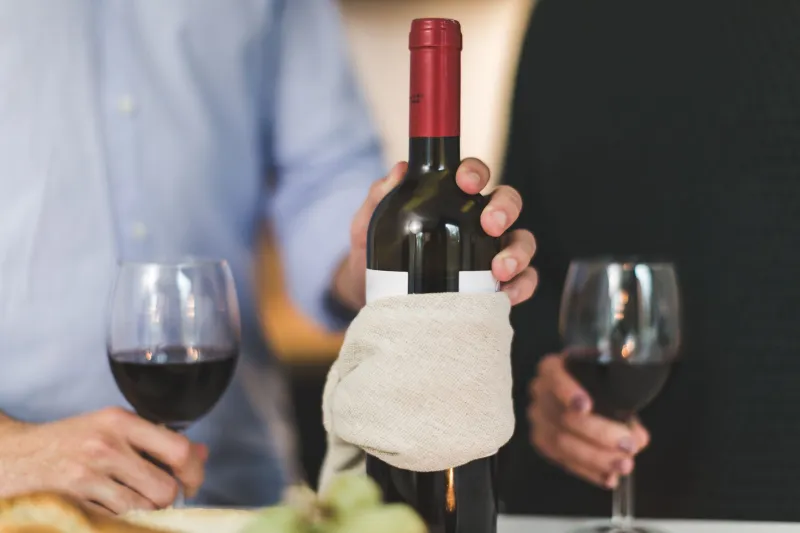
If you're at a nicer restaurant, the server usually handles the first pour—which honestly removes a lot of drama. Let them do their job. Don't hover. Don't redirect the bottle mid-pour. Just let it happen.
The Art of the Equitable Top-Up
Once the bottle is open and flowing, the real social math begins. Keeping track of who's had what is somewhere between a mild headache and a full-blown group project, depending on how much everyone's already had.
The general vibe in Canadian group settings is this: keep glasses roughly equal. If you're reaching for the bottle, check the table first. If someone's running low, pour them a bit before you refill yourself. It's not about being a martyr—it's about the collective experience staying enjoyable for everyone.
The person who consistently over-pours themselves without checking in will absolutely be talked about on the drive home. This is a fact.
Splitting the Bill: The Real Test
Okay, here's where it gets spicy. The bottle arrives, it gets enjoyed, and then the server drops the bill. Suddenly everyone's doing mental calculations that rival a first-year accounting exam.
The cleanest approach—and the one most Canadians default to—is splitting the bottle evenly among the people who drank from it. If three people had wine and one person stuck to beer, the bottle cost gets divided by three. Straightforward. Civilized. Done.
Where it gets complicated: the person who had one glass versus the person who had three. Technically they both "shared the bottle," but the split doesn't feel equal. In Canada, we tend to avoid making a big deal of this in the moment—but if it's a recurring pattern with the same person, it's worth addressing outside of the restaurant, preferably over text where the awkwardness is slightly more manageable.
Also worth noting: if you suggested the bottle, you're not automatically on the hook for the whole thing. That's not how this works. That's never been how this works.
The Last Glass Problem
There is always a last glass. And in Canada, nobody wants to take it.
The final pour from a shared bottle is a minefield of politeness. Everyone sees it. Nobody wants to seem greedy. So it just... sits there. Sometimes for an embarrassingly long time.
Here's the move: offer it around the table. If someone wants it, great. If not, either split it between two people or just pour it yourself without making a ceremony of it. What you should absolutely not do is ask the server if you can "finish it off" with a dramatic gesture. Just drink the wine.
When Someone Doesn't Drink (Or Drinks Way Less)
This one matters. If someone at the table isn't drinking—whether they're pregnant, sober, on medication, or just not feeling it—they should never be pressured into the bottle split. Full stop.
Most Canadians are pretty good about this, but there's still that one person who says "oh come on, just have a sip" like it's the 1990s. Don't be that person. The non-drinker already navigated the gentle social pressure of the original bottle suggestion. They don't need to also subsidize everyone else's Pinot Gris.
If someone's clearly not drinking from the bottle, quietly adjust the split. It's not a big deal. It actually makes you look like a decent human being.
The Second Bottle Conversation
So the first bottle is gone and someone—usually the same person who suggested the first one—floats the idea of a second. This is a whole different negotiation.
By now, people know how the night is going. Some are ready to commit. Others are starting to think about their 7am alarm. The rule here is simple: no guilt trips either way. If half the table wants another bottle and half doesn't, order by the glass or split a half-bottle if the restaurant offers it.
And if you're the one pushing for round two, read the room. Not everyone's night is on the same trajectory as yours, and that's completely fine.
The Takeaway
Sharing a bottle in Canada is one of those small social acts that says a lot about how you show up for the people you're out with. It's not about the wine—it's about the consideration, the awareness, and the willingness to make the experience good for everyone at the table.
Pour generously. Split fairly. Don't hoard the last glass. And maybe, just maybe, let someone else suggest the second bottle for once.
Your night out will be better for it. So will your friendships.