How to Read the Room: The Unofficial Playbook for Canadian Nightlife
There's no orientation package when you walk into a Canadian bar for the first time. Nobody hands you a laminated card explaining that yes, you really should tip your coat check person, or that showing up exactly when the event starts is somehow both acceptable and slightly awkward depending on which city you're in. You're just supposed to know.
But of course, most people don't — at least not right away. Canadian nightlife has its own rhythm, its own social grammar, and a whole collection of quietly held expectations that locals follow almost instinctively. For visitors, newcomers, or even Canadians who've recently relocated from one province to another, decoding that grammar can take a while.
Consider this your shortcut.
Tipping Isn't Optional — It's Cultural
Let's start with the one that trips people up the most: tipping. In Canada, gratuity isn't a reward for exceptional service — it's a baseline expectation built into how service industry workers are compensated. When you're out at a bar or club, tipping your bartender a dollar or two per drink (or 18–20% on a tab) isn't generosity. It's just the done thing.
And it doesn't stop at the bar. Coat check staff? Tip them. Bottle service? Absolutely tip, and generously. Even the person who brings a round of waters to your table during a long night deserves a nod. Canadians who frequent the same spots tend to build quiet reputations with staff — the good tippers get remembered, get better service, and sometimes get waved past a lineup. The ones who don't tip? Also remembered, just differently.
This culture extends to how Canadians treat service workers in general — with a baseline of respect and acknowledgment that visitors from some countries occasionally find surprising. It's not performative; it's just how things work here.
Punctuality Is... Complicated
Here's where it gets a little regional. Ask a group of Torontonians what time a party actually starts and they'll tell you the invitation time is more of a suggestion — showing up 30 to 45 minutes late is standard, even expected. Arrive right on the dot in many Toronto social circles and you'll find the host still getting dressed.
Head out west to Vancouver, and the vibe shifts slightly. There's a more laid-back, go-with-the-flow energy, but also a stronger outdoor-activity culture that means people often have earlier bedtimes than their eastern counterparts. Events there can move faster and wind down sooner than you'd expect.
In Montréal, the night doesn't really begin until well after midnight. The city's notoriously late-starting club scene means that heading out at 10 p.m. is practically an afternoon activity. Pre-drinking (or prédrinking, as it's sometimes called) is practically a social institution there, with gatherings at someone's apartment before hitting the clubs becoming as much a part of the night as the clubs themselves.
The takeaway: always read the local cues, and when in doubt, ask a friend who actually lives there.
Dress Codes: What's Written vs. What's Actually Expected
Most Canadian venues that enforce dress codes will post them — no athletic wear, no open-toed shoes for men, that kind of thing. But the unwritten version of the dress code is often more nuanced.
In cities like Calgary and Edmonton, the bar scene can range from country-casual to surprisingly upscale depending on the neighbourhood and the night. In Montréal, looking effortlessly stylish is almost a civic duty — the bar for what counts as "dressed up" is genuinely higher, and the fashion sensibility leans more European than elsewhere in the country. In Halifax or St. John's, the atmosphere tends to be more relaxed and unpretentious — overdressing can actually make you stand out in the wrong way.
The general rule across the country: clean, intentional, and put-together will almost always get you through the door and into a comfortable social groove. Canadians aren't flashy as a rule, and the nightlife culture tends to reflect that — stylish but not showy, confident but not loud.
How Canadians Actually Talk to Strangers at the Bar
If you've spent time in places like New York or London, you might be used to a certain directness — or a certain guardedness — when it comes to strangers striking up conversation. Canadian bar culture sits somewhere in the middle, with some important regional flavour.
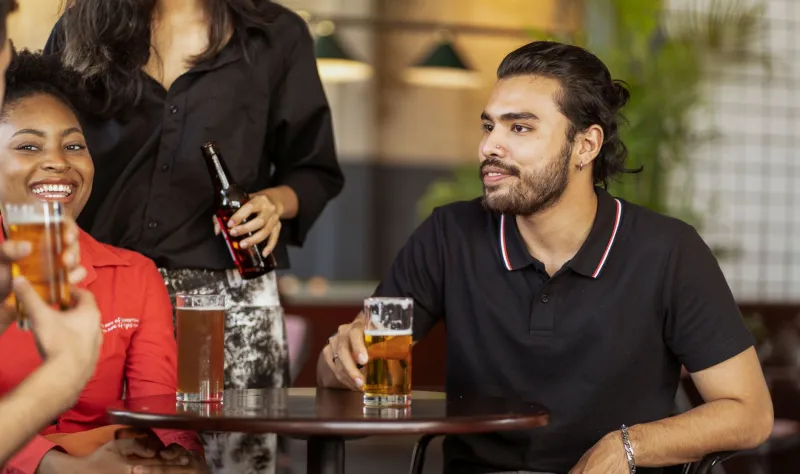
Generally speaking, Canadians are friendly but not immediately open. There's a warmth that comes out once the ice is broken, but the initial approach tends to be low-key. Aggressive flirting, over-the-top openers, or dominating someone's space are quick ways to get a polite but firm shutdown. A comment about the game on the screen, a question about someone's drink, or even a mutual eye-roll about the lineup for the bathroom — these are the kinds of organic entry points that work.
Apologies are practically a second language. If you bump into someone, you both apologize. If someone bumps into you, you might also apologize. It sounds absurd until you're living it, and then it just feels like basic decency.
One more thing: Canadians tend to be conflict-averse in public spaces. Loud arguments, aggressive behaviour, or even just talking over people will earn you some serious side-eye. The social pressure to keep things pleasant is real and quietly enforced by everyone in the room.
The Regional Divide Is Real
It's worth saying plainly: "Canadian nightlife" isn't one thing. The experience of going out in Québec City is fundamentally different from going out in Winnipeg, which is different again from a night in downtown Vancouver or a Friday in Charlottetown. Language, climate, local industry, and cultural heritage all shape what people do, where they go, and how they behave when the sun goes down.
In French-speaking Québec, the social culture around going out is more communal and conversation-driven — lingering over drinks for hours is the norm, and the food-and-drink integration is tighter. In the Prairie provinces, there's often a stronger connection between nightlife and live music, with a honky-tonk undercurrent that doesn't really exist in the same way on the coasts. Atlantic Canada brings a storytelling, kitchen-party spirit to its bars that feels genuinely distinct from anything you'll find in a major urban centre.
The Bottom Line
What makes a Canadian night out feel distinctly Canadian isn't any one thing — it's the accumulation of all these small, often unspoken habits and expectations. The tip that says you respect the person pouring your drink. The apology that smooths over an accidental shoulder bump. The outfit that's polished but not trying too hard. The conversation that opens slowly and then, once it does open, goes somewhere genuinely interesting.
Learn to read those cues and you're not just surviving a night out in Canada — you're actually part of it. And that, honestly, is where the best nights happen.